
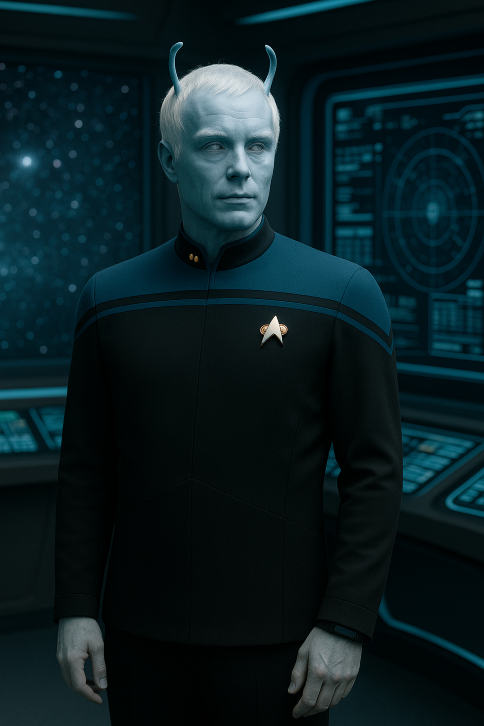
Lieutenant Sherev th’Zal
Name Sherev th’Zal
Position Astrometrics Officer
Rank Lieutenant
Character Information
| Gender | Male | |
| Species | Andorian (Aenar subspecies) | |
| Age | 34 |
Physical Appearance
| Height | 6' 1" | |
| Weight | 176 lbs | |
| Hair Color | White | |
| Eye Color | Opalescent/milky (congenitally blind) | |
| Physical Description | Sherev moves with deliberate economy, “reading” spaces through touch, airflow and deck vibration. He habitually brushes a bulkhead, hatch frame or deck join on entry, then settles with unhurried poise. His antennae track voices and ventilation harmonics; when concentrating he taps a slow, even rhythm with two fingertips. Up close, the opalescent sheen of his eyes is striking rather than unsettling. His voice is low and even, with a cool Andorian cadence that rarely rises under pressure. |
Family
| Spouse | Ithari zh’Vek (female) Aenar navigator, Northern Ice Reaches enclave; bonded within the Zal bond-group. Maintains long-distance bond with Sherev via haptic-encoded correspondence; reunion leave every 2–3 years when postings permit. |
|
| Children | Serin th’Zal (male, born 2382) — resides in the Northern Ice Reaches enclave with the bond-group; curious, already “maps” rooms by touch. Avi sh’Zal (female, born 2385) — cheerful, responds to haptic lullabies; beginning way-song lessons. Co-Parents (bond-quartet, per Andorian custom): Maeri zh’Zal (female) — archivist’s assistant; keeper of the younglings’ memory strands. Thalas ch’Vek (male) — corridor safety rigger; Ithari’s kin-line. Note: The children remain with the bond-group on Andoria; Sherev and Ithari maintain regular haptic-encoded correspondence with them and coordinate leave for reunions when postings permit. |
|
| Father | Tharash th’Zal Ice-corridor engineer, Aenar Enclave navigation grid. Calm, exacting, quietly proud of Sherev’s Starfleet service though wary of politics. Chalin ch’Zal Acoustic cartographer, teaches tactile mapping to enclave youth; staunch pacifist who worries Starfleet asks too much of “good listeners.” |
|
| Mother | Zheiri zh’Zal Healer and consent-ethics advocate; serves on the enclave’s Mediation Circle. Shalen sh’Zal Archivist of ice-songs (environmental resonance records); keeps the family’s memory strands and festival rites. |
|
| Brother(s) | Tarev th’Zal (younger) — off-world apprentice at the Andorian Diplomatic Mission on Mellstoxx III; fascinated by non-Aenar cultures, occasionally writes to Sherev about “what the stars sound like.” Kaelan ch’Zal (kin-adopted cousin) — hydroponics technician for the Enclave’s winter reserves; pragmatic, mildly sceptical of Starfleet but adores Chloe’s exported recipes via Sherev. |
|
| Sister(s) | Ithiri zh’Zal (older clutchmate) — environmental linguist, liaises with the Andorian Science Institute; pushes for wider Aenar engagement with the Federation. Friendly point of friction with Chalin’s pacifism. Veshal sh’Zal (younger clutchmate) — enclave way-finder; lost partial hearing after a glacial collapse and now co-designs safer training runs. Quiet hero vibes. |
|
| Other Family | Elder Saaru zh’Zal (great-aunt) — retired navigator; living repository of enclave histories. Can authenticate old way-songs or call the family to order. Rhevan sh’Vaal (maternal uncle by bond) — security liaison to Laibok; believes the Coalition Liberation Front’s rhetoric endangers Aenar neutrality. Potential CLF debate foil. Current Status (2387) The Zal bond-home remains in the Northern Ice Reaches Aenar enclave. Family respects Sherev’s oath-bound ethics; differing views on Starfleet create gentle, values-based tension rather than estrangement. They exchange haptic-encoded letters (thin resonant plates) instead of visual holos. |
Personality & Traits
| General Overview | Quietly steady and principled, Sherev leads with calm rather than volume. He listens first—people, hull, telemetry—then speaks in concise, actionable lines. The dry wit surfaces when tension needs a slow release, never at someone’s expense. Collaboration is his default; he turns complex models into clear choices others can actually fly, and he’s protective of juniors, building their confidence without taking their work out of their hands. His ethics are non-negotiable—consent and scientific integrity come before optics—and that spine makes him a trusted voice when politics press in. He’s not aloof so much as economical: feelings are acknowledged, not performed. Under pressure he becomes an anchor—cadence even, boundaries clear—and only later does he notice what the long watch cost him. He avoids the spotlight, credits the team, and would rather fix three small frictions than make one grand speech. If a line is crossed, he can be stubborn; otherwise he is patient, courteous, and quietly kind, the officer who resets a room with a minute of shared silence and then gets everyone moving in the same direction. |
|
| Strengths & Weaknesses | Strengths: Sherev is a world-class pattern inferrer with a gift for multi-sensor fusion; he “listens” to subspace the way a conductor reads a score and translates that intuition into crisp, flyable risk envelopes for CONN. His crisis cadence is exemplary—voice low, timing exact—allowing him to anchor a bridge even when telemetry turns chaotic. Technically, he excels at convoy safety modelling, long-baseline drift archives, and haptic-forward interfaces that make astrometrics truly collaborative rather than visual-only. Ethically, he is immovable on consent and scientific integrity, which makes him a trusted adviser when politics and maths collide. Interpersonally, he is calm, dry-witted, and generous with juniors, turning their anomaly “hunches” into method and mentoring them into confident briefers. Weaknesses: Sherev over-owns outcomes and will quietly burn himself down to keep others steady, under-communicating fatigue until it affects judgement. His ethical spine, while admirable, can harden into stubbornness; once he deems a course unjust, he is difficult to budge, even when command needs a fast compromise. He can be reluctant to delegate under pressure, preferring to validate every layer of a model himself. Sensory-wise, heavy electromagnetic noise or poorly calibrated haptic feeds can overwhelm his usual read of a space, forcing him to pause or seek alternate inputs. Politically, he tends to assume good faith and may underestimate how actors like the Coalition Liberation Front weaponise optics, leaving him vulnerable to being blindsided outside the lab unless partnered with a savvier operator. |
|
| Quirks | Hull-listener: On entry, he touches a bulkhead or deck join, then goes quiet for a few seconds to “hear” the room before speaking. Base-eight murmur: Counts softly in octal when aligning long-baseline drift archives; crew recognise it as his “thinking loop.” Haptic mail: Sends and saves family letters on thin resonance plates; keeps one in his pocket as a grounding token. Cold bias: Prefers cooler compartments and drops lab temps a notch on night shifts; dresses perfectly regulation but sleeves slightly looser for antenna comfort. Tea & silence: Night-shift ritual—peppermint tea with Chloe, first minute in companionable silence to reset his senses. Quiet metronome: Taps a slow, even rhythm with two fingertips when modelling; speeds up only in true emergencies (a tell for CONN/Sec). Antenna etiquette: Angles antennae down when others are distressed—an Aenar courtesy signalling he’s listening but not probing. Map names that stick: Gives anomalies simple, memorable nicknames (“The Bruise”, “Scarp Wind”), which end up on briefings. Consent check-ins: Before any empathic read deeper than ambient affect, he states the scope and asks for explicit consent—even under pressure. Soundscape tinkerer: Carries a thumb-sized microchime; uses it to test echo and airflow in new spaces, then pockets it like nothing happened. |
|
| Ambitions | Sherev wants to make the Moore’s convoy-safety models the sector standard—elegant tools that any bridge can fly under pressure, not just specialists in a quiet lab. He’s intent on proving that ethical routing and lifesaving outcomes aren’t opposites, even with CLF optics grinding at the edges of every decision. Longer term, he hopes to build a small cadre of junior “listeners” who can read subspace the way he does—through haptic, sonic, and tactile layers—so the work endures without him. If he does his job properly, the maps outlive the mapper. |
|
| Hobbies & Interests | Sherev gravitates to quiet, tactile pastimes: holo-ice climbing with realistic thermal physics, Andorian string etudes adapted for resonance he can feel through his fingertips, and late-shift peppermint tea in the mess where the first minute is shared silence. He keeps a pocket microchime to sample new rooms, collects haptic-encoded letters from home, and annotates starfields with plain-spoken nicknames—“The Bruise,” “Scarp Wind”—that make complex charts human to fly. He enjoys mentoring juniors by turning their “hunches” into method, running short workshops on haptic/sonic map reading, and trading practical recipes with Chloe for cold-weather comfort food. When off duty he’ll sometimes tune the ship’s ambient soundscape by ear—vent baffles, loose panel screws, a misaligned door seal—because a quiet hull makes better maps. |
| Personal History | Born into the Zal bond-group in the Aenar enclave of Andoria’s Northern Ice Reaches, Sherev grew up in a culture that navigates the world by echo, texture and temperature as naturally as others use sight. His early education mixed consent ethics and mediation practice with practical way-finding: counting in base-eight while tracing ice corridors by fingertip, learning to “hear” air pressure changes across carved tunnels, and reading the minute twitches of antennae as effortlessly as tone. Family trades shaped him—Tharash’s engineering precision, Chalin’s acoustic cartography, Zheiri’s healer’s boundaries, and Shalen’s stewardship of memory strands—instilling a quiet duty to map clearly and act cleanly. A formative event came in his mid-teens when a glacial overhang sheared during a training run, leaving his younger clutchmate Veshal partially deaf. Sherev joined the safety review that followed, helping Chalin redesign the route with haptic beacons and resonant “way-songs” that could be followed by touch as well as sound. The incident hardened his instinct to turn intuition into method and to make maps others can trust under stress. By sixteen he was prototyping simple tactile star charts on thin resonance plates; by seventeen he’d resolved to take those skills off-world, with elder navigator Zhelar zh’Vek mentoring him through Academy entrance prep while the bond-group debated—gently but earnestly—what it meant for an Aenar “listener” to serve among the stars. Starfleet Academy (2371–2375) Admitted on the Aenar cultural outreach track, Sherev majored in Astrophysics with a minor in Computational Cartography, splitting time between San Francisco and the Mellstoxx III campus. He gravitated to subspace dynamics, sensor fusion and convoy modelling, and quietly became the cadets’ go-to for turning dense maths into briefings CONN could actually fly. During crisis-management practicums he developed his trademark cadence—calm, sparse, actionable—which instructors noted as “stabilising under load.” The Dominion War years reshaped his focus. Training cruises were repurposed for relief convoys; Sherev embedded with an accessibility working group to make astrometric outputs usable under stress by mixed crews. His senior project—a haptic-forward astrometric interface that layered tactile and sonic cues over standard star maps—earned a Fleet Innovation Commendation (team) and later informed Copernicus Fleet Yards’ corridor tools. Alongside the technical work he completed advanced ethics modules on consent and telepathy, formalising Aenar practice within Starfleet regs. By graduation he held certifications in Subspace Dynamics (Level II at the time), EVA in cold environments, and convoy risk routing, with strong faculty recommendations for an Astrometrics billet. Dominion War Aftermath / Junior Tours (2375–2381) Assigned to the Nebula-class USS Curie straight out of graduation, Sherev cut his teeth on post-war relief and stabilisation runs where subspace lanes were still bruised by years of overuse. As Astrometrics Technician (Ensign) he built long-baseline drift logs and translated them into flightable briefings for CONN, quietly earning a reputation for turning noise into navigable options. He helped stand up a haptic/sonic overlay in the Curie’s lab so mixed-ability teams could read the same map under pressure, and he took every cold-weather EVA he could get, arguing that “a calm hull makes better maps.” Promoted to Lt. (jg) on an Intrepid-class detachment aboard the USS Intrepid, he became Astrometrics Specialist and acting night-watch lead. During a corridor wobble near a refugee corridor, he co-authored a shear-avoidance profile that prevented cascading EPS stress across a small convoy—earning a Captain’s Letter of Commendation and cementing his crisis cadence: speak less, decide cleanly, buy time. Between missions he mentored junior technicians in haptic-forward workflows and formalised a pocket checklist for convoy risk that would later expand into the sector playbook used at Copernicus Fleet Yards. Sector Astrometry & Liaison (2381–2387) Posted to Copernicus Fleet Yards’ Corridor Stability Cell as a Lieutenant, Sherev shifted from shipboard problem-solver to sector-wide mapper. He consolidated long-baseline drift archives from multiple platforms into a living “fluid map” of subspace shear, tuning it for real-time convoy routing that junior bridge crews could actually fly. He partnered with Engineering to standardise haptic/sonic overlays so visually dense cartography translated into tactile cues at the helm, and he wrote the first iteration of the C-CRR pocket protocol—a three-step checklist for rapid, ethical corridor decisions during degraded telemetry. As humanitarian and mixed-traffic convoys became political footballs, Sherev was seconded to ethics panels mediating between operations, colonial governors and the rising Coalition Liberation Front (CLF). He argued—successfully in several hearings—that mathematically “optimal” routes which stranded non-Federation civilians were operationally unsound and strategically corrosive. Notable actions included pre-emptive rerouting around a developing shear river that would have trapped a relief group, and a forensic reconstruction of a “gravitic bruise” suggesting clandestine weapons testing near a CLF logistics lane. By 2387 he’d become the quiet standard-setter other astrometry cells borrowed from: briefings that were crisp under fire, models that respected consent and law, and a habit of buying Command time without mortgaging principles. Bond & Family (2381–2387) During his Copernicus Fleet Yards posting, Sherev formalised a long-distance bond with Ithari zh’Vek (Aenar navigator, Northern Ice Reaches). Their bond follows Aenar consent practice and Andorian four-part custom, with co-parents Maeri zh’Zal and Thalas ch’Vek completing the child-rearing circle. Their first youngling, Serin th’Zal (b. 2382), arrived amid the early Corridor Stability Cell work; Avi sh’Zal (b. 2385) followed as the lane maps matured. The children remain with the bond-group on Andoria, exchanging haptic-encoded letters and lullaby way-songs with Sherev and Ithari until reunions can be arranged. Balancing duty and distance shaped Sherev’s choices: he declined short-notice postings that offered prestige but little humanitarian impact, favouring work that made convoys safer and timelines kinder to families at the margins. By 2387, with CLF optics tightening around route decisions, the bond-group endorsed his return to line service so his models could be applied where they mattered most—an agreement grounded in clear boundaries, planned leave, and the shared belief that just maps serve all their children. Transfer to USS Moore (2387) With corridor politics sharpening around the Coalition Liberation Front, Sherev requested a return to line service where his convoy-safety models would matter at the point of decision. Endorsed by Copernicus Fleet Yards’ Corridor Stability Cell, he accepted an Astrometrics Officer posting aboard the USS Moore, drawn by the ship’s reputation for principled operations under pressure and its tight Science–Security–CONN integration. With the Science Department presently without a formal head, Sherev arrives prepared to keep astrometric outputs clear and flyable while the department stabilises. |
|
| Service Record | 2371–2375 — Starfleet Academy — Cadet — Astrophysics (major), Computational Cartography (minor) 2375–2378 — USS Curie (Nebula-class) — Ensign — Astrometrics Technician 2378–2381 — USS Intrepid (Intrepid-class det.) — Lieutenant (jg) — Astrometrics Specialist / Acting Night-Watch Lead 2381–2387 — Copernicus Fleet Yards, Corridor Stability Cell — Lieutenant — Sector Astrometry (Convoy Routing & Risk) 2387–Present — USS Moore — Lieutenant — Astrometrics Officer |
|
| Awards & Decorations | Fleet Innovation Commendation (Team) — 2375 For the haptic-forward astrometric interface developed at the Academy; later informed Copernicus Fleet Yards’ corridor tools. Captain’s Letter of Commendation — 2379 For co-authoring a shear-avoidance profile that prevented cascading EPS stress across a refugee convoy (USS Intrepid detachment). Starfleet Unit Citation — 2376 Awarded to the crew of the USS Curie for exemplary relief and stabilisation operations in Dominion War aftermath lanes. Humanitarian Service Cluster — 2384 Civilian evacuation support within the Copernicus Fleet Yards AO during corridor instability events. Reprimands/Disciplinary Actions: 2382 — Counselled, not reprimanded (Copernicus Fleet Yards): Informal note for exceeding authorised lab hours during a corridor shear analysis. Supervisor recorded “commendable intent; reminder to observe fatigue limits.” No further action. Starfleet Campaign Service Ribbon (Post-War Stabilisation) — 2375–2377 For sustained participation in post-conflict relief convoys and corridor security operations. |